


Studies & Publications
Research, studies and publications that focus on issues and workers in the informal economy. ILI provides a space for knowledge-sharing and a methodology for grassroots-led research.
34 publications
Showing page 1 of 4 (page size: 9).
Ordered by most recent publication date.
Case Study: The Future of Work: Worker Organizing and Power in Africa's Informal Economy - Kenya National Waste Pickers Welfare Association (KeNaWPWA)
The Future of Work: Worker Organizing and Power in Africa's Informal Economy The Future of Work report includes case studies which spotlight how new worker groups mobilize different power resources across contexts. Selected to reflect sectoral, geographic diversity and organizational maturity, the cases also illuminate effective power-building strategies and pathways, successes and enduring constraints, drawing out replicable lessons for new worker groups. This case study features Kenya National Waste Pickers Welfare Association (KeNaWPWA).
Case Study: The Future of Work: Worker Organizing and Power in Africa's Informal Economy - Federation of All Uganda Migrant Workers Associations (FAUMA)
The Future of Work: Worker Organizing and Power in Africa's Informal Economy The Future of Work report includes case studies which spotlight how new worker groups mobilize different power resources across contexts. Selected to reflect sectoral, geographic diversity and organizational maturity, the cases also illuminate effective power-building strategies and pathways, successes and enduring constraints, drawing out replicable lessons for new worker groups. This case study features Federation of All Uganda Migrant Workers Associations (FAUMA).
Case Study: The Future of Work: Worker Organizing and Power in Africa's Informal Economy - Domestic Services Workers Union of Ghana (DSWU)
The Future of Work: Worker Organizing and Power in Africa's Informal Economy The Future of Work report includes case studies which spotlight how new worker groups mobilize different power resources across contexts. Selected to reflect sectoral, geographic diversity and organizational maturity, the cases also illuminate effective power-building strategies and pathways, successes and enduring constraints, drawing out replicable lessons for new worker groups. This case study features Domestic Services Workers Union of Ghana (DSWU).
Case Study: The Future of Work: Worker Organizing and Power in Africa's Informal Economy - The Amalgamated Union of App-Based Transporters of Nigeria (AUTON)
The Future of Work: Worker Organizing and Power in Africa's Informal Economy The Future of Work report includes case studies which spotlight how new worker groups mobilize different power resources across contexts. Selected to reflect sectoral, geographic diversity and organizational maturity, the cases also illuminate effective power-building strategies and pathways, successes and enduring constraints, drawing out replicable lessons for new worker groups. This case study features The Amalgamated Union of App-Based Transporters of Nigeria (AUTON).
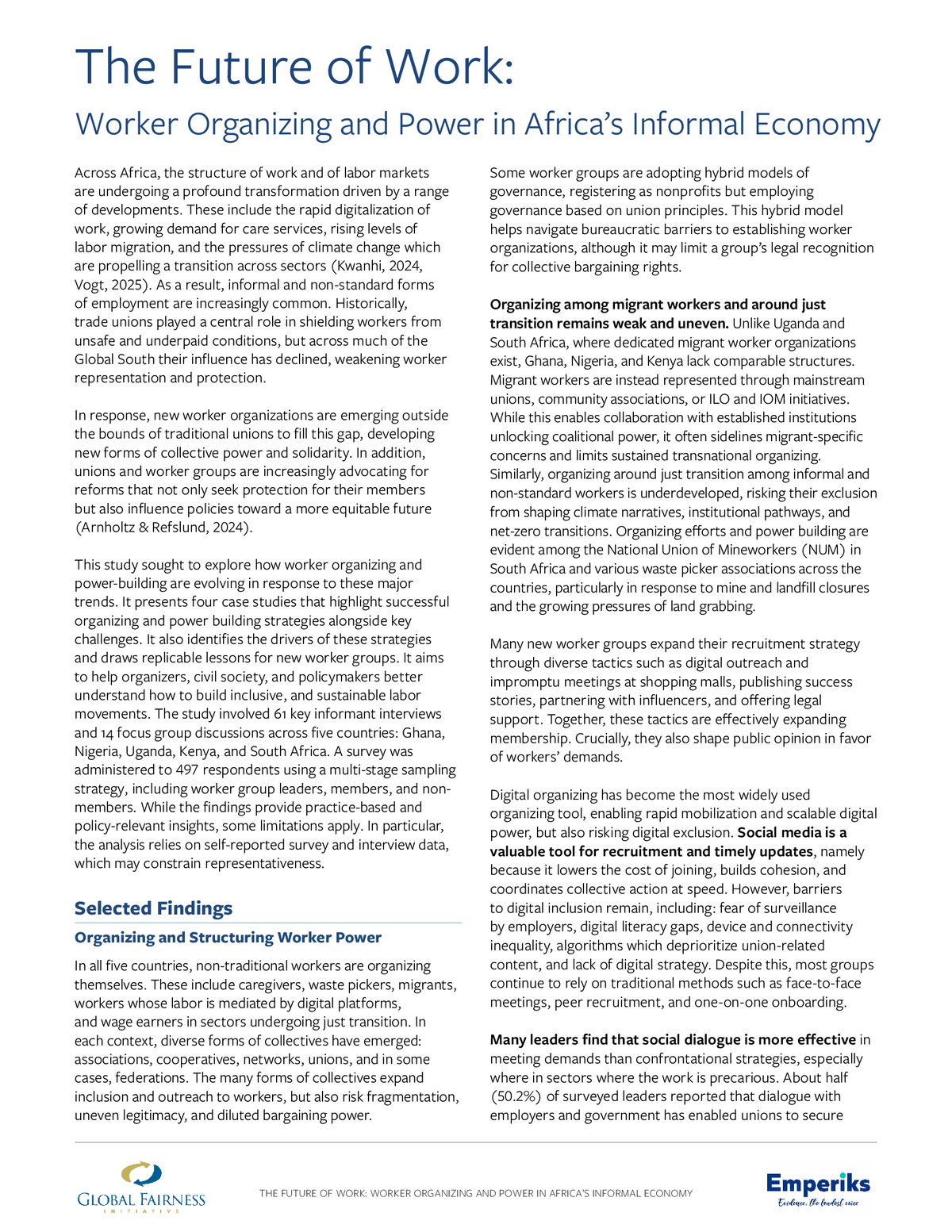
Factsheet: The Future of Work: Worker Organizing and Power in Africa's Informal Economy
Factsheet: The Future of Work: Worker Organizing and Power in Africa’s Informal Economy Across Africa, the structure of work and of labor markets are undergoing a profound transformation driven by a range of developments. These include the rapid digitalization of work, growing demand for care services, rising levels of labor migration, and the pressures of climate change which are propelling a transition across sectors. As a result, informal and non-standard forms of employment are increasingly common. In response, new worker organizations are emerging outside the bounds of traditional unions to fill this gap, developing new forms of collective power and solidarity. In addition, unions and worker groups are increasingly advocating for reforms that not only seek protection for their members but also influence policies toward a more equitable future. The Future of Work: Worker Organizing and Power in Africa’s Informal Economy FACTSHEET highlights central findings how worker organizing and labor power-building are evolving in response to major shifts, and offers recommendations to strengthen collective action and policy engagement for meaningful worker power and wellbeing.
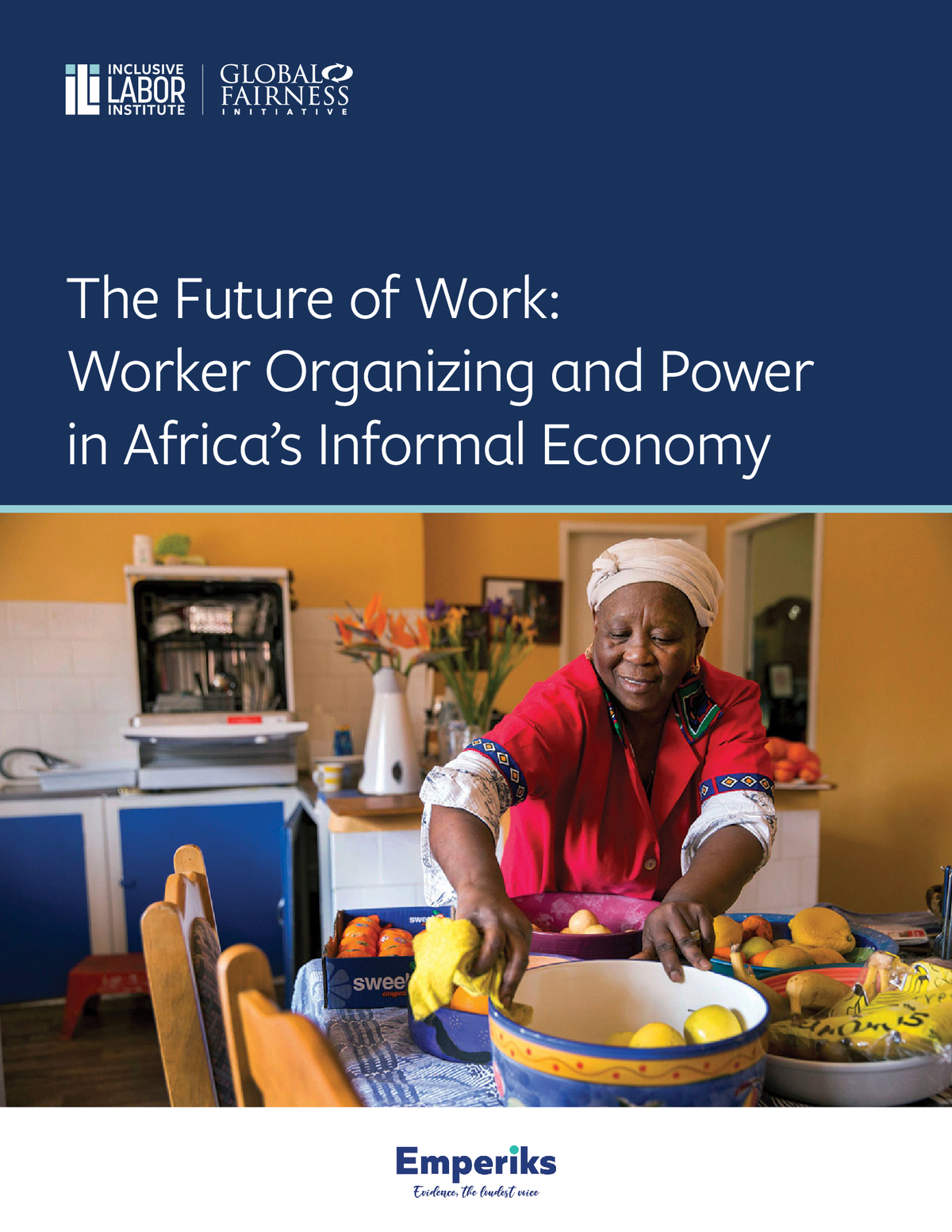
The Future of Work: Worker Organizing and Power in Africa's Informal Economy
Across Africa, the structure of work and of labor markets are undergoing a profound transformation driven by a range of developments. These include the rapid digitalization of work, growing demand for care services, rising levels of labor migration, and the pressures of climate change which are propelling a transition across sectors. As a result, informal and non-standard forms of employment are increasingly common. Historically, trade unions played a central role in shielding workers from unsafe and underpaid conditions, but across much of the Global South their influence has declined, weakening worker representation and protection. In response, new worker organizations are emerging outside the bounds of traditional unions to fill this gap, developing new forms of collective power and solidarity. In addition, unions and worker groups are increasingly advocating for reforms that not only seek protection for their members but also influence policies toward a more equitable future. The Future of Work: Worker Organizing and Power in Africa’s Informal Economy Study seeks to explore and document how worker organizing and labor power-building are evolving in response to major shifts in the structure of work throughout the continent. The study focuses on five countries: Ghana, Nigeria, Uganda, Kenya, and South Africa, to explore the central question: How are new worker groups organizing—attracting, recruiting, and mobilizing—outside the traditional labor movement in response to Africa’s changing work landscape? These findings inform the recommendations to strengthen collective action and policy engagement for meaningful worker power and wellbeing.
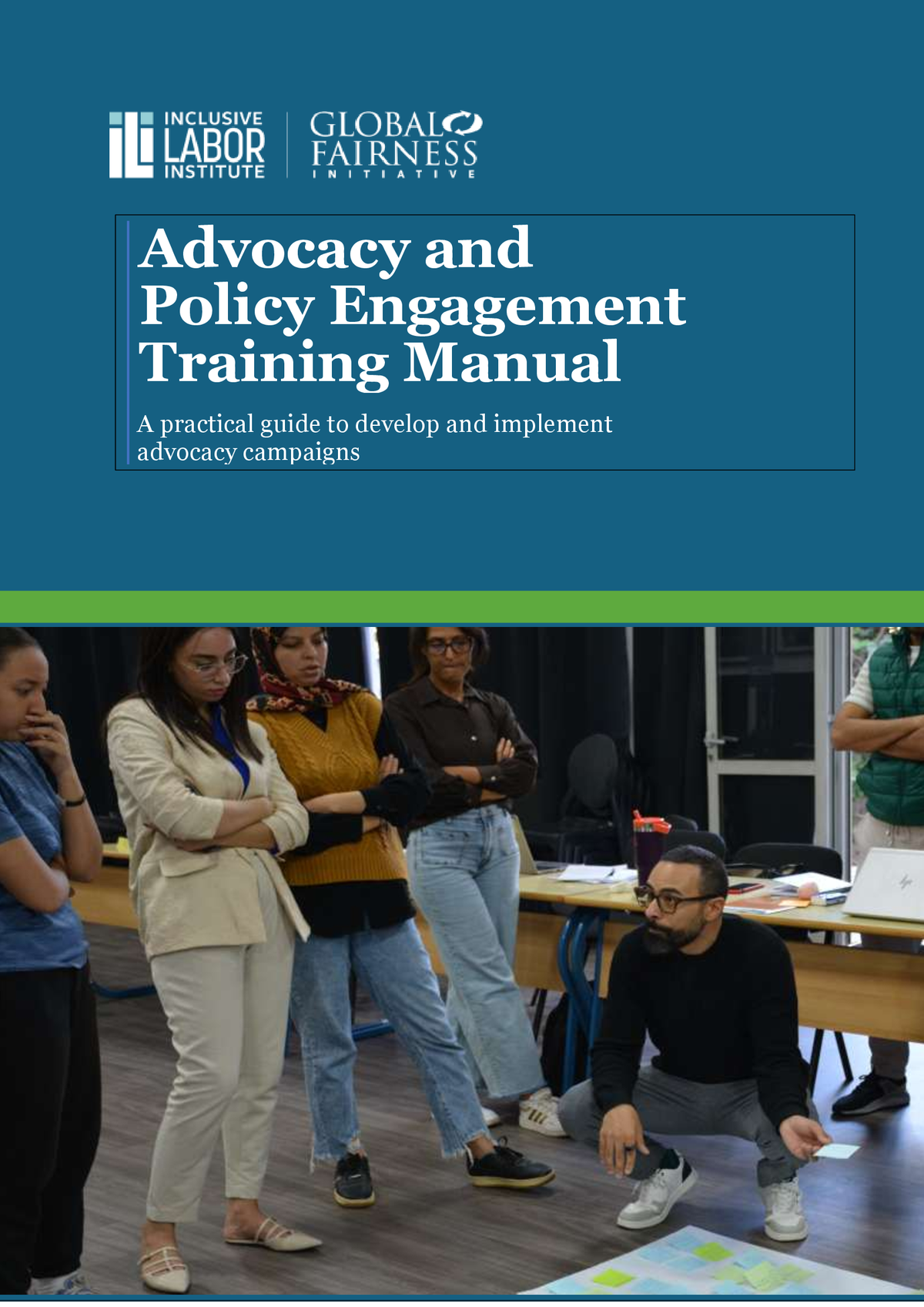
ILI Resource: Advocacy and Policy Engagement Training Manual
This Trainer-of-Trainers (ToT) style curriculum is intended to lead a trainings for worker-led organizations to learn and practice foundations of advocacy and policy engagement. The main objective of this guide is to provide a reference framework and practical tools to design, implement, and evaluate advocacy and policy engagement initiatives aimed at influencing decision- makers to recognize, protect, and promote human rights. The guide is organized into ten complementary sections: 1. Understanding Advocacy 2. Strategic Foundations of Advocacy 3. Steps in Advocacy Planning 4. Advocacy Tools 5. Advocacy Strategies 6. Advocacy Tactics 7. Communication and Influence 8. Political Engagement 9. Developing and Implementing an Action Plan 10. Monitoring, Evaluation, and Sustainability Each section combines a theoretical framework, practical tools, exercises and case studies to encourage learning by doing, and operational recommendations for turning knowledge into concrete action.
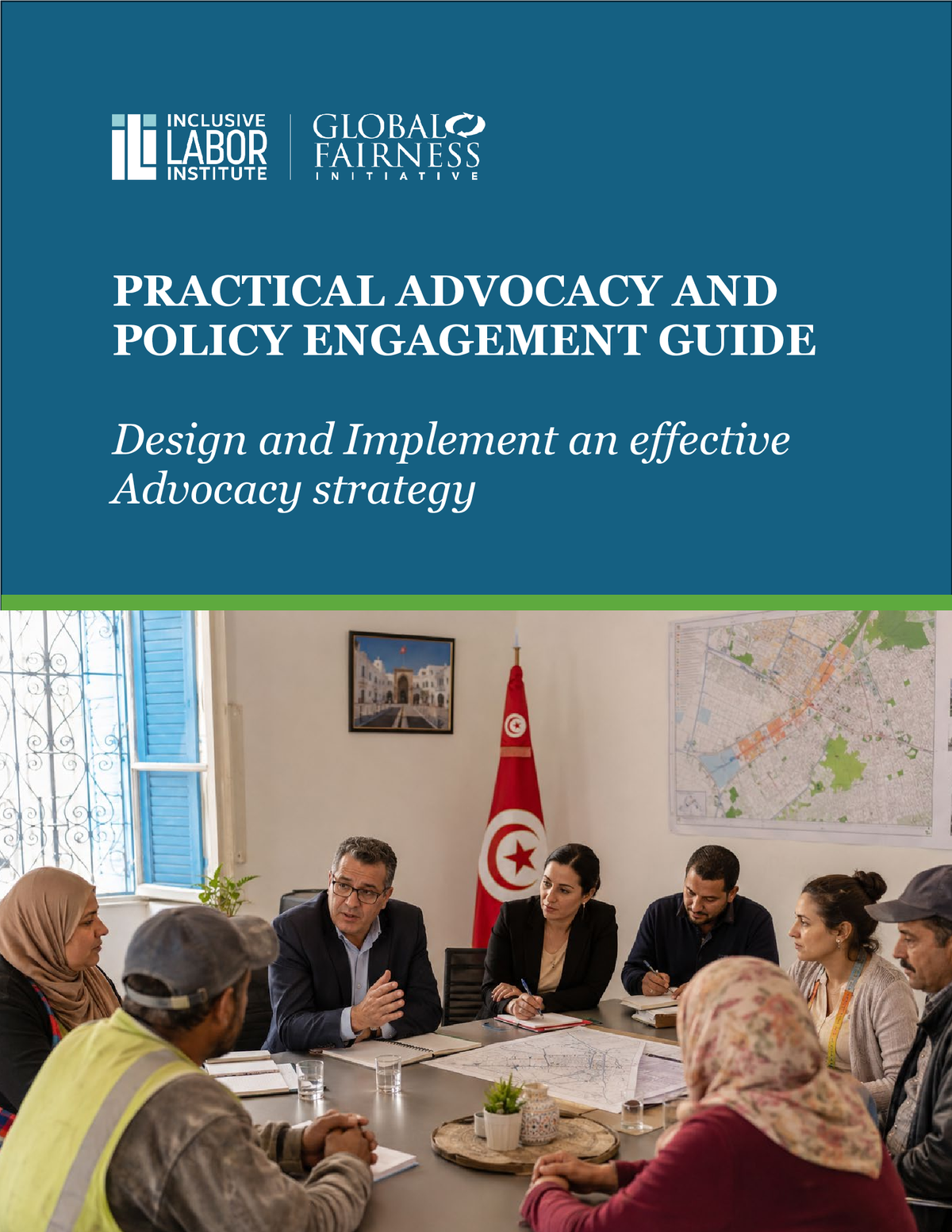
ILI Resource: Practical Advocacy and Policy Engagement Guide
This self-directed guide is intended for worker-led organizations to learn and practice foundations of advocacy and policy engagement. The guide is organized into 4 major phases: 1) Analyze 2) Plan 3) Communicate & Act and 4) Evaluate & Sustain. Each phase ends with practical worksheets for worker-led organizations to design an implement an effective advocacy strategy.
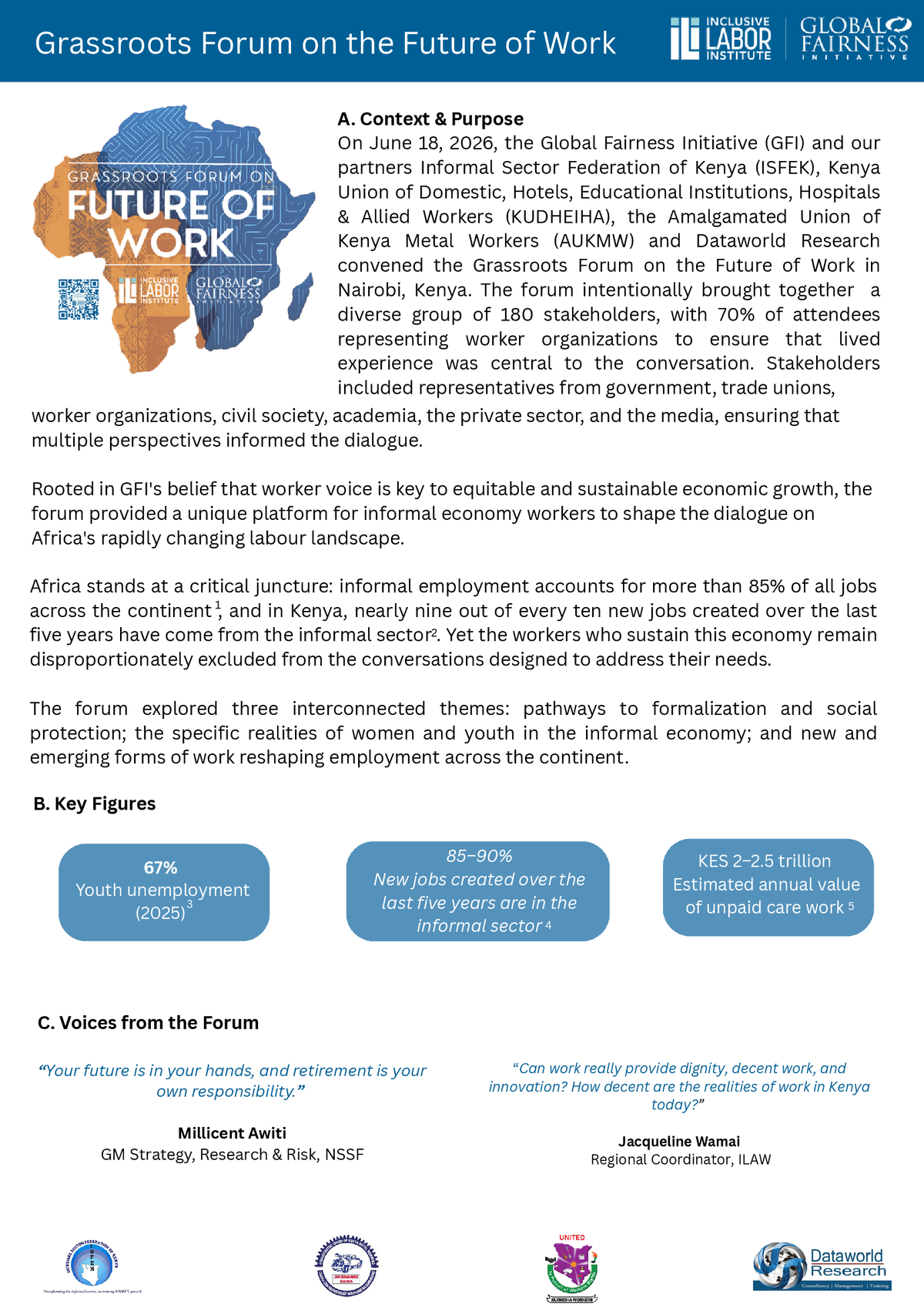
Factsheet: Grassroots Forum on the Future of Work
In June, Global Fairness Initiative (GFI) and our partners, the Informal Sector Federation of Kenya (ISFEK), Kenya Union of Domestic, Hotels, Educational Institutions, Hospitals & Allied Workers (KUDHEIHA), the Amalgamated Union of Kenya Metal Workers (AUKMW) and Dataworld Research convened the Grassroots Forum on the Future of Work in Nairobi, Kenya. Rooted in GFI's belief that worker voice is key to equitable and sustainable economic growth, the forum provided a unique platform for informal economy workers to shape the dialogue on Africa's rapidly changing labour landscape. The forum explored three interconnected themes and developed recommendations on: pathways to formalization and social protection; the specific realities of women and youth in the informal economy; and new and emerging forms of work reshaping employment across the continent.