


Studies & Publications
Research, studies and publications that focus on issues and workers in the informal economy. ILI provides a space for knowledge-sharing and a methodology for grassroots-led research.
34 publications
Showing page 2 of 4 (page size: 9).
Ordered by most recent publication date.
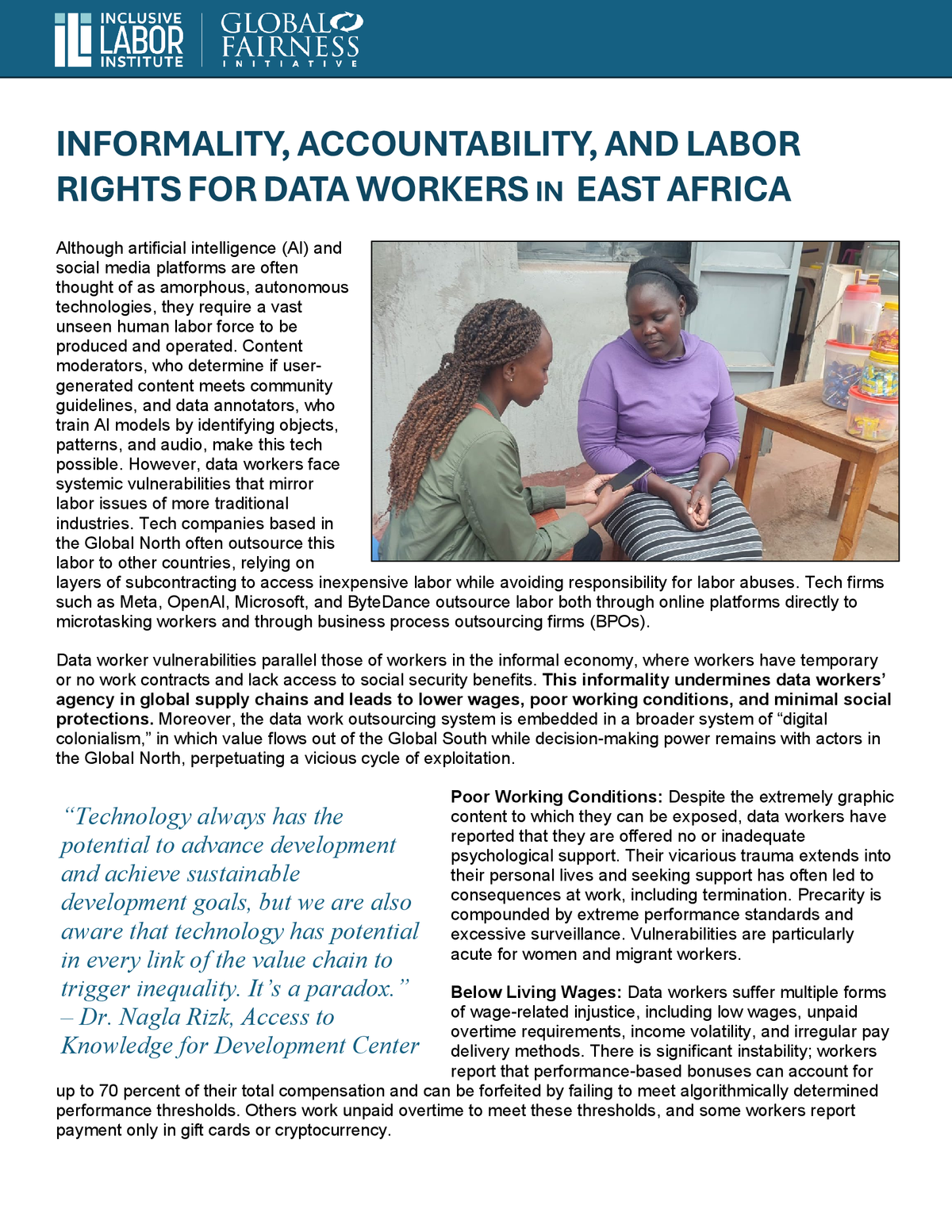
ILI Factsheet: Informality, Accountability, and Labor Rights for Data Workers in East Africa
Although artificial intelligence (AI) and social media platforms are often thought of as amorphous, autonomous technologies, they require a vast unseen human labor force to be produced and operated. Content moderators, who determine if user-generated content meets community guidelines, and data annotators, who train AI models by identifying objects, patterns, and audio, make this tech possible. Data worker vulnerabilities parallel those of workers in the informal economy, where workers have temporary or no work contracts and lack access to social security benefits. This informality undermines data workers’ agency in global supply chains and leads to lower wages, poor working conditions, and minimal social protections. Moreover, the data work outsourcing system is embedded in a broader system of “digital colonialism,” in which value flows out of the Global South while decision-making power remains with actors in the Global North, perpetuating a vicious cycle of exploitation.
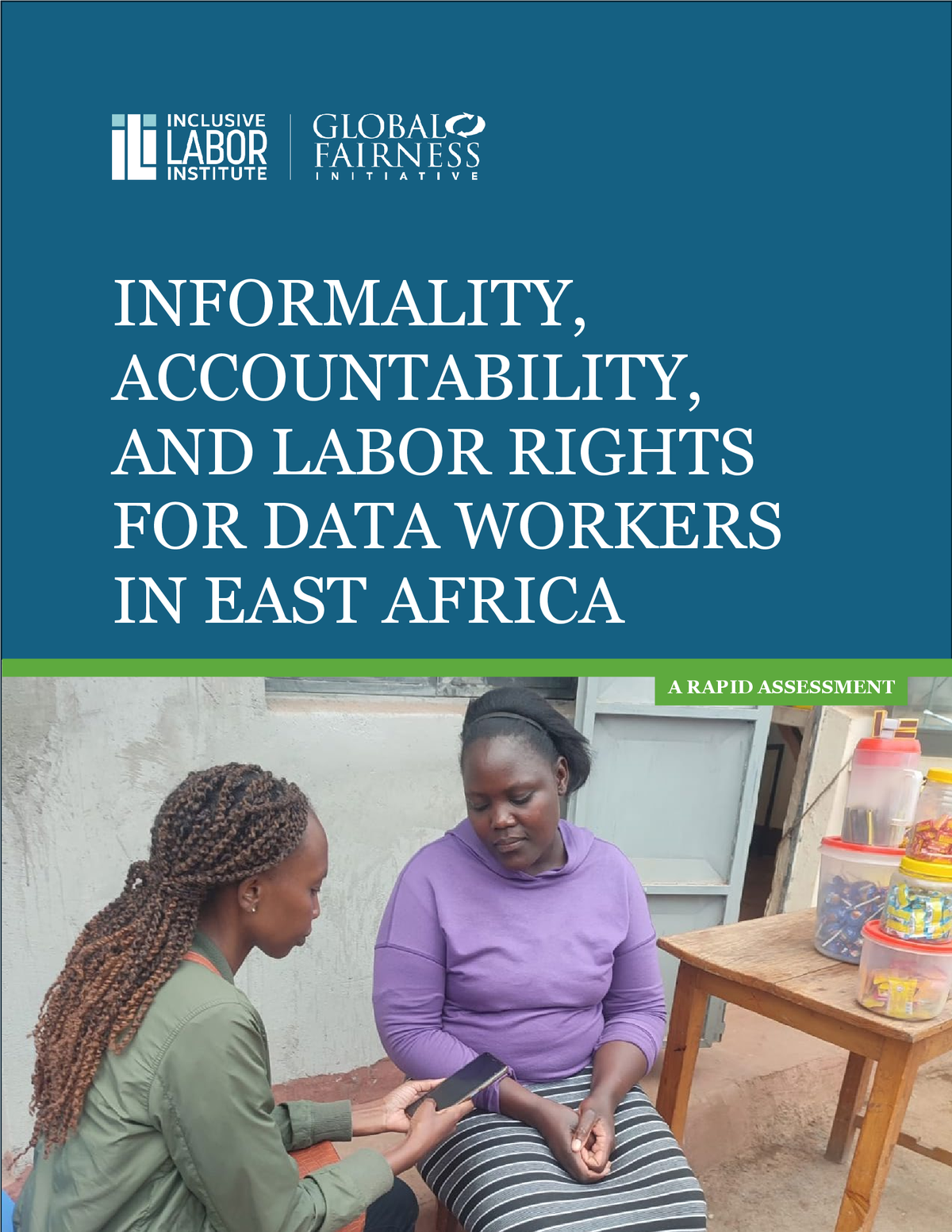
Informality, Accountability, and Labor Rights for Data Workers in East Africa
Although artificial intelligence (AI) and social media platforms are often thought of as amorphous, autonomous technologies, they require a vast unseen human labor force to be produced and operated. Content moderators, who determine if user-generated content meets community guidelines, and data annotators, who train AI models by identifying objects, patterns, and audio, make this tech possible. Data worker vulnerabilities parallel those of workers in the informal economy, where workers have temporary or no work contracts and lack access to social security benefits. This informality undermines data workers’ agency in global supply chains and leads to lower wages, poor working conditions, and minimal social protections. Moreover, the data work outsourcing system is embedded in a broader system of “digital colonialism,” in which value flows out of the Global South while decision-making power remains with actors in the Global North, perpetuating a vicious cycle of exploitation.
New Forms of Work, Old Forms of Exploitation: An Analysis of Tunisia's Platform and Informal Economies
Tunisia, like the majority of developing countries, is experiencing an expansion of informality, both in the number of people employed and in terms of the number of informal sectors. The platform economy is one of these areas of expansion in the informal economy. Informal work is generally characterized by a lack of social protection; undefined workplaces; indecent working conditions; low-skill work; irregular incomes; and difficult access to finance, training, and government benefits. Despite sharing high rates of informality as characterized by lack of formal registration, the platform economy may not necessarily have many other characteristics in common with the traditional informal economy. Given its relative novelty, work in the sector may present new challenges in terms of rights and protections but also may provide new opportunities in terms of employment and income. To address these possibilities, our study aims to better understand the social and economic situation of informal workers in the platform economy. This report was carried out with support from the MENA Observatory on Responsible AI, under the Access to Knowledge for Development Center (A2K4D), housed at the Onsi Sawiris School of Business, The American University in Cairo.
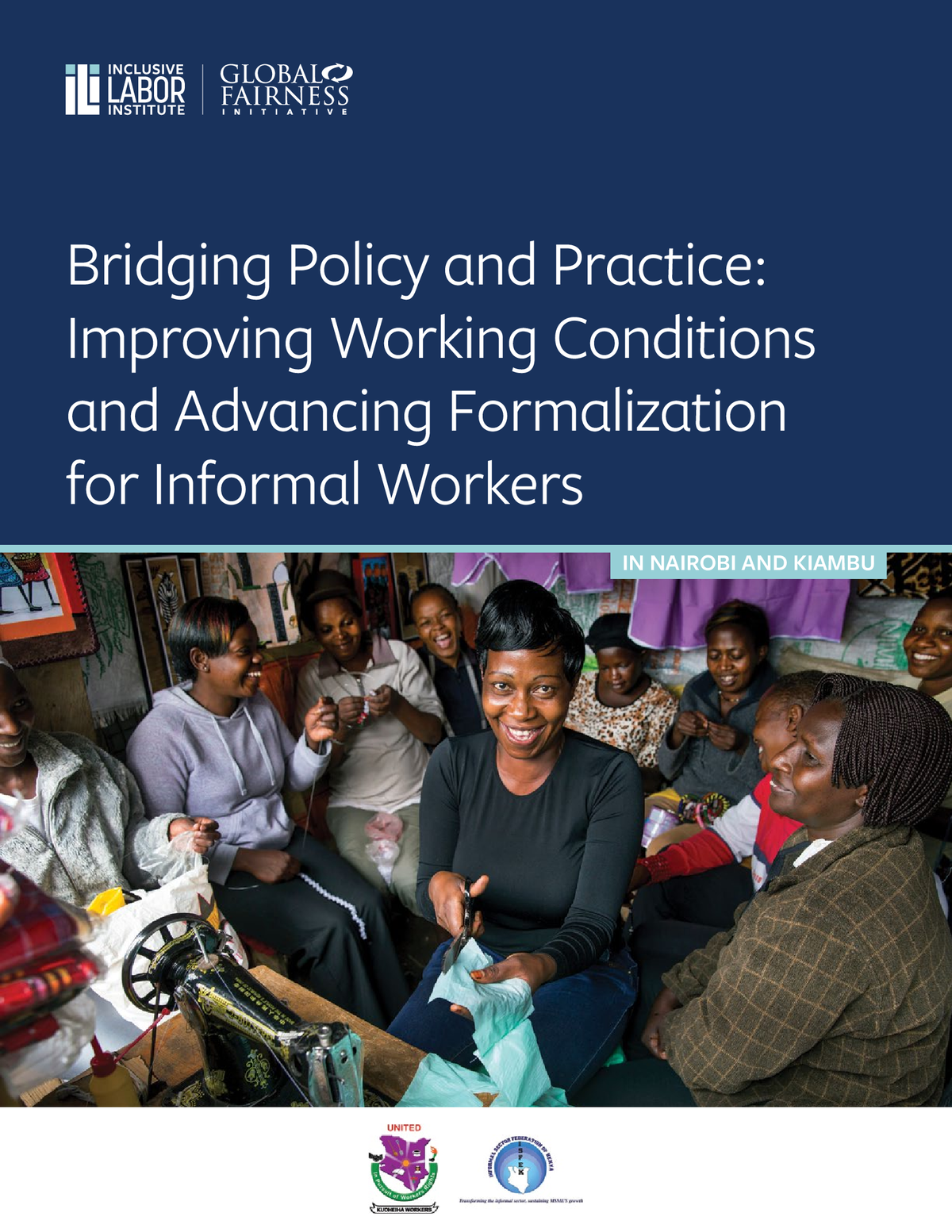
ILI Study: Bridging Policy and Practice: Improving Working Conditions and Advancing Formalization for Informal Workers in Nairobi and Kiambu
The study examined the working conditions of informal workers in Nairobi and Kiambu counties to assess the existing policies and explore opportunities for formalization. The study was motivated by recognition that informal workers are a critical source of livelihood in Kenya, providing employment and sustaining millions of livelihoods. The sector is dominated by women and youth who engage in street vending, domestic work, small-scale trading, and artisanal services as sources of income. While this sector has proven to be resilient and adaptive, it is also marked by instability, poverty, and exclusion from the protections and benefits available in the formal economy.
Towards Climate and Extreme Heat Resilience: Lessons from African and Asian Communities
This issue of Southasiadisasters.net, coordinated by All India Disaster Mitigation Institute and Inclusive Labor Institute, brings together powerful insights from Africa and Asia on how communities are confronting climate change and extreme heat. From informal workers adapting to rising temperatures and girls’ education strengthening long-term resilience, to community-led early warnings in Tajikistan, agroforestry in Ghana, and heat-safe urban practices in India, the issue showcases practical, scalable solutions emerging from the ground up. Featuring contributions from 16 authors across the region, it highlights one message clearly: communities are not waiting—they are innovating, adapting, and leading the way toward a more climate-resilient future. Find other issues of southasiadisasters.net here: aidmi.org/topic/southasiadisasters-net/
Women, Work, and the Informal Economy in Uganda: What’s Holding Businesses Back?
This report presents the findings of the research study on the barriers to business formalization and entrepreneurship gaps and challenges faced by women in informal business in Kampala, Wakiso, Mayuge, and Mbarara districts, Uganda. The study was conducted by the Council for Economic Empowerment for Women in Africa, Uganda in Chapter (CEEWA-U) and the Uganda Hotels Food, Tourism, Supermarkets and Allied Workers’ Union (HTS-Union), commissioned by Global Fairness Initiative (GFI). The study is being implemented by GFI under the Grassroots Center for Women in Work (GCWW) initiative in Uganda. The purpose of this research was to examine why informal business owners are not transitioning to the formal sector as well as to understand the entrepreneurial and capacity gaps faced by women-owned informal businesses.
Climate Adaptive Strategies of Rural Women in Upper East and West Ghana
This study, conducted in May 2025, explores the role of rural women farmers in strengthening agricultural productivity through climate change adaptation in Ghana’s highly vulnerable Upper East and Upper West Regions. Drawing on a mixed-methods design, which combined surveys with 628 farmers and 20 focus group discussions involving 160 participants, the research offers critical insights into the challenges, strategies, and outcomes of adaptation from a gendered perspective. Findings reveal that climate change is universally experienced among farmers in these regions, primarily through erratic rainfall patterns, prolonged droughts, and rising temperatures. The foremost challenge is financial, as the cost and limited availability of critical inputs, particularly improved seeds, prevent many farmers from fully embracing more effective strategies. Despite these barriers, the study highlights the tangible benefits of adaptation. Most farmers reported improvements in yields and household food security, and average farm income increased more than threefold. The study concludes that rural women farmers are at the forefront of climate resilience, actively contributing to food security and productivity despite structural and systemic limitations. Empowering rural women farmers by addressing these systemic constraints is not only a matter of equity but a strategic pathway to ensuring national food security and building resilient agricultural systems in the face of accelerating climate change.
ILI Resource: Data Collection Techniques Training Curriculum
This Trainer-of-Trainers (ToT) style curriculum addresses why data matters, its impact on decision-making and the future of work. The resource is intended for worker-led organizations to harness the power of evidence-based decision-making.
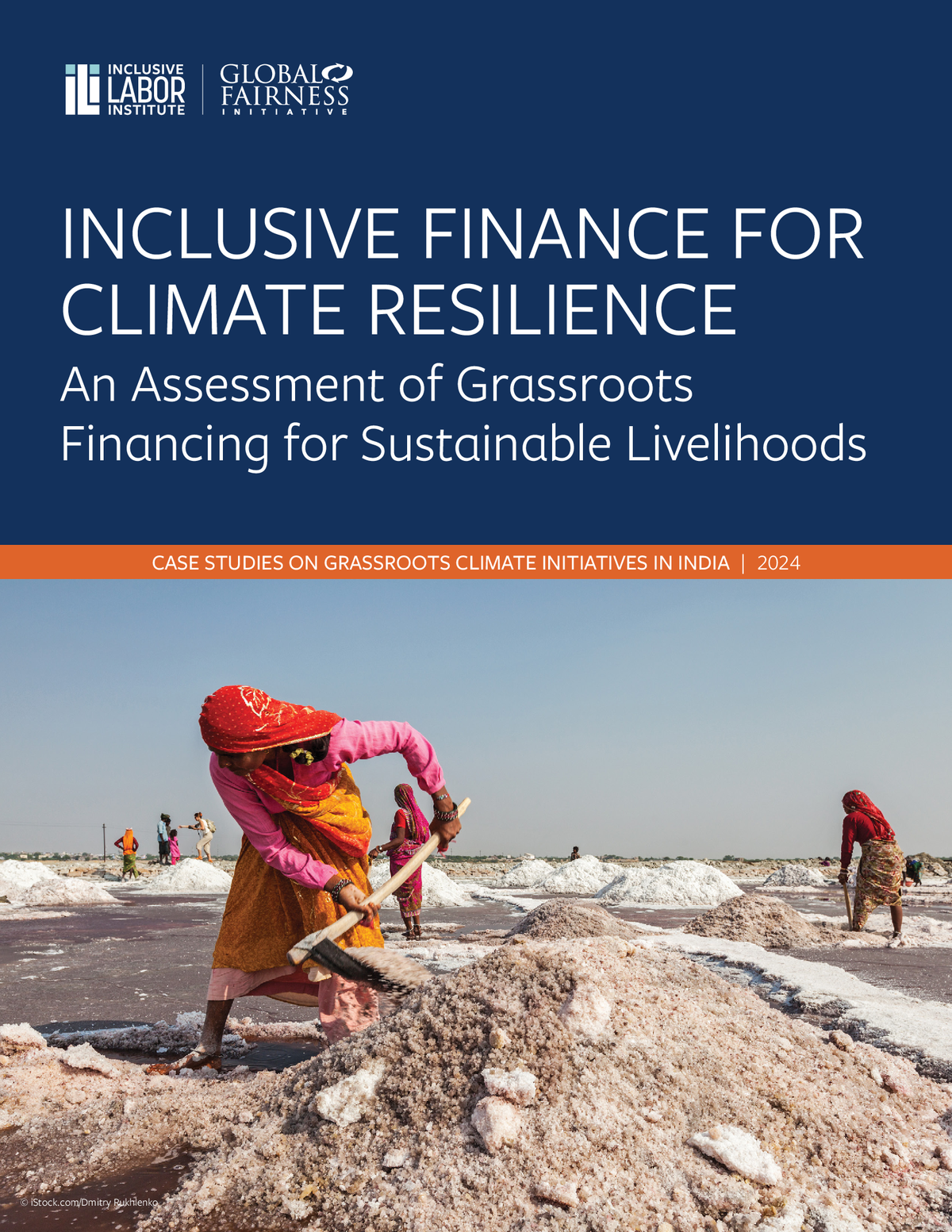
Inclusive Finance for Climate Resilience: An Assessment of Grassroots Financing for Sustainable Livelihoods
Over the past decade, climate disasters in India have upended thousands of small and marginal producers and workers lives and livelihoods. Across sectors, informal and vulnerable workers, primarily women, are disproportionately impacted by climate change and are pushed further into poverty as they struggle on the front lines of the climate crises. Since 2000, the Self-Employed Women’s Association (SEWA) and the American India Foundation (AIF) have worked to enhance financial stability and prosperity for its members through the transition to green technology and into the green economy in what is termed as building ‘climate resilience’. SEWA and AIF help build the skills, capacity, and confidence of workers to have livelihood security and resources to withstand the changing physical landscape and the significant increase of climate and economic shocks. In 2024, Global Fairness Initiative (GFI), an international NGO with experience in evaluating economic empowerment of women, assessed the impact of SEWA’s and AIF’S on-going initiatives designed to engender inclusive financial growth and development through climate resilience. The following report focuses specifically on SEWA’s and AIF’s efforts, and the economic and social impact of those efforts, while also articulating the investment framework and financial partners and model used within each case study. The purpose of the report is to present different case examples of climate-linked financial models and their scope, structure and impact. Through primary and secondary data collection, GFI’s assessment found that small and marginal producers, mainly women, gain stability and security as a result of targeted financial solutions that address specific climate challenges. When initial investments are activated, women producers reported sustained increases in their income, and a reinvestment of their income into their businesses and to climate friendly solutions linked to livelihood security. Furthermore, opportunities for expanded investments by SEWA and AIF to sustain and scale up successful models can provide further wrap-around support to deepen resilience against climate shocks for workers and communities.