


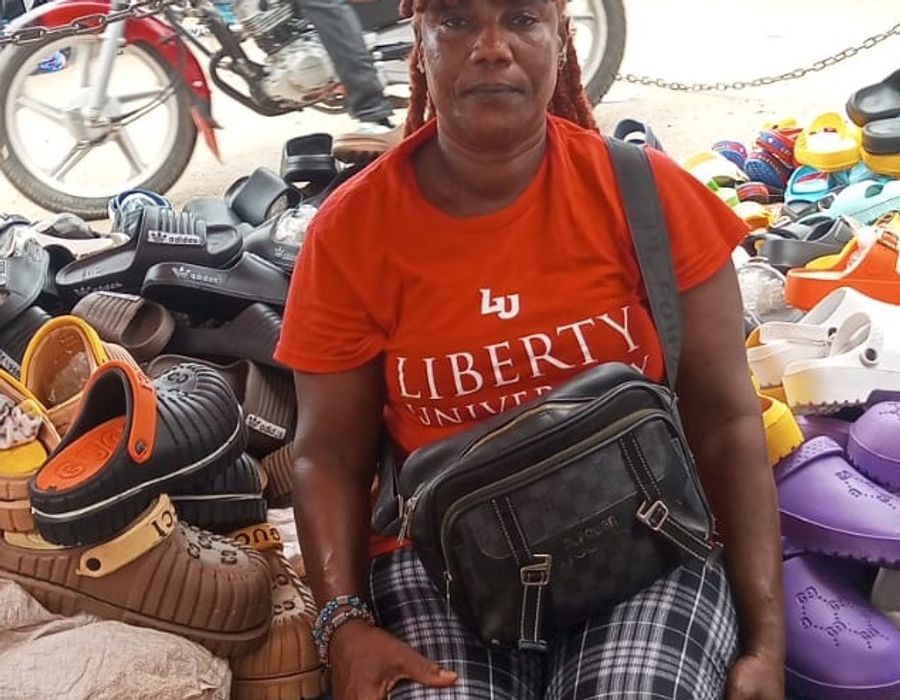
Two years ago, Mortee’s husband died of a heart attack at just 50 years old. Suddenly a single mother with four young girls to care for, Mortee wasn’t sure how her family would survive. Her work as a street vendor selling slippers and footwear in Montserrado County, Liberia, used to be a side income to supplement her husband’s construction job. But now her sales have become the family’s lifeline. “I’ve been greatly challenged because the business I’m doing is the only source of income to pay for my kids in educating them and caring for their needs,” says Mortee. “I also have to pay the house rent, and I have no other means of getting money except through this business.”
With the pressure on, Mortee began to focus on how to make more money by scrambling and selling more shoes. Some days she sells 10 or 15 pairs, whereas other days she sells none. She began to give herself goals. Mortee sells her shoes for about 130 Liberian dollars, or 75 cents a pair. Her goal is to bring in at least 1,500 Liberian dollars, or $8 U.S. dollars a day. A good day would be making between $10 and $15 U.S. dollars.
“This is how I feed my children, take care of their health and school costs.”
Mortee owns her own business, buying the footwear in bulk in Liberia or from shops in other countries. She sells them to people who walk down the street, some locals and some out-of-towners. She also sells to retail buyers to make more money. She offers more than ten different types of shoes, including pairs for kids, men and women.“People think it’s easy to sell at the market, but it’s not,” she says. “With shoes, you have to wash them, clean them, polish them and put them in transparent plastic before they are ready for sale.” Then, she puts them in a wheelbarrow and carries them around looking for customers. Selling shoes on the streets isn’t for the faint of heart. There’s the blistering heat, the moving around and the police who often chase street workers away. “We talk a lot, encouraging customers to buy, explaining why our shoes are better than others.”
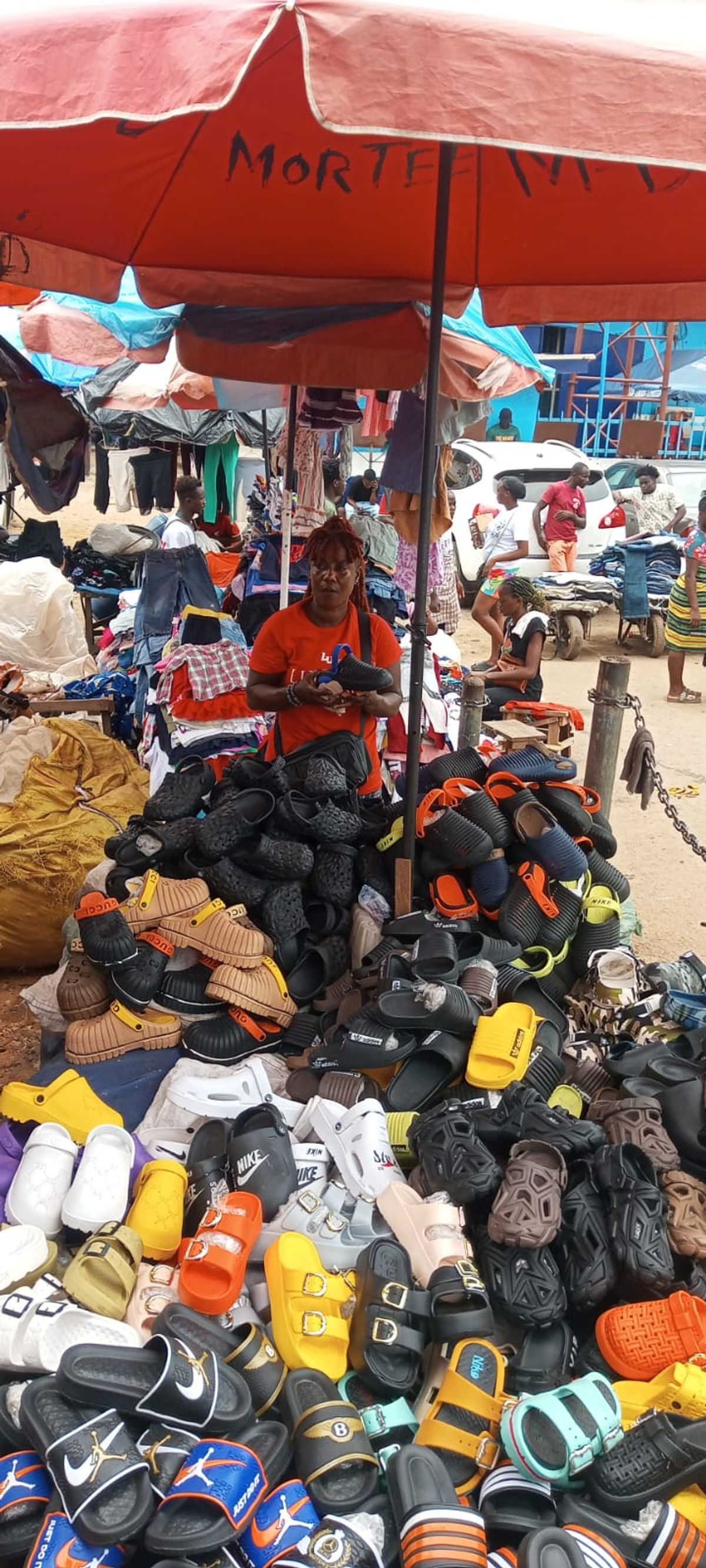
Mortee's Shoe Business
Mortee got into the business after calling her friend and asking about selling as a street vendor, and her friend said, “You can do this too.” Her friend told her where to go and encouraged her to set up her own shop. “This is how I feed my children, take care of their health and school costs,” says Mortee. Her friend encouraged Mortee to join the union because she was signing up too, and the union offered protection.
The two women signed up with The Federation of Petty Traders and Informal Workers’ Union of Liberia (FEPTILWUL). It’s an informal economy trade union organization with women workers making up the majority of the market space. In 2009, a few young Liberians created this organization to give street sellers and informal traders in Liberia’s informal sector a voice, as the informal economy comprises approximately 42.7% of the total economy, according to the London-based think tank World Economics. FEPTIWUL’s goal is to train and educate its members on the importance of negotiation, bargaining and fiscal discipline so they acquire the skills to gradually transform from the informal trading sector to the formal economy.
“The unions speak up for us and fight for our rights when there are problems. Before, street sellers never had any rights.”
Currently, there aren’t any clear rules to help street sellers with places to sell. For now, the police give them certain areas where they are allowed to set up shop, but it’s not always clear where those are, aside from the fact that the main street and sidewalks are off limits. “The police don’t want us to sell on the streets, but we don’t have anywhere else to go,” says Mortee. Sometimes the police will come in and destroy their things, saying it’s illegal. But the unions stand up for them, talk to the cops, and iron out what places are legal. “The unions speak up for us and fight for our rights when there are problems,” says Mortee. “Before, street sellers never had any rights.” Joining the union has made a huge difference in her life, she says.
According to interviewed leaders and members of FEPTIWUL, the police harassment has really decreased, and street vendors are now much more relaxed at work. The working relationship with local municipalities has improved.
While Mortee has made the best of her small business, she hopes her kids focus on their schoolwork and do something else. “I’m a high school dropout, and I would have to be trained to do another job,” says Mortee. “For now, this is easier because I know this world.” But her daughters have the option to choose something else that’s perhaps easier and more lucrative, and she hopes they will. “They are young and energetic,” she says.
In the future, Mortee hopes to grow her business, because the larger it is, the more people come in and buy, and the more money she has for her family. “I’ve grown because I have to. I’m the only caretaker of small children,” says Mortee. “I’m working really hard just for my kids.”